
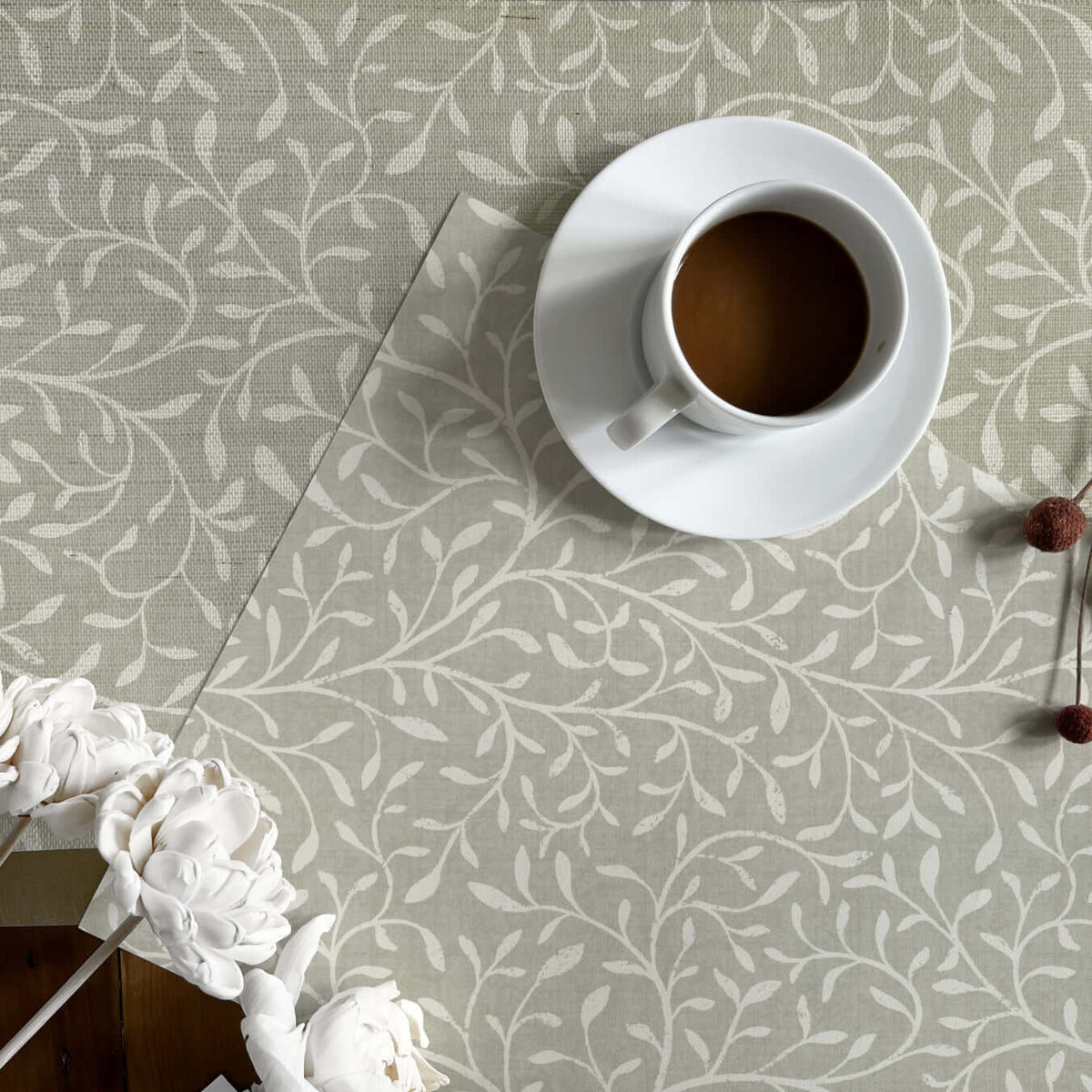
What Is Pre Pasted Wallpaper? An Honest Guide from the Designer
So, what is pre pasted wallpaper? Most people weighing up wallpaper get stuck on the same two options: traditional wallpaper vs peel and stick. It's the question everyone ends up Googling.
But there's a third option that hardly gets a mention, and I think that's a shame. Pre pasted wallpaper sits quietly in between, and most people either don't know it exists or aren't sure what it involves.
So this is my attempt to fix that. I'll walk you through what pre pasted wallpaper is, how it goes up, and where it works. I'll be honest about the bits I know well and the bits I'm still learning.

What Is Pre Pasted Wallpaper?
So, what is pre pasted wallpaper? Exactly what it sounds like.: the paste is already on the back of the paper. You don't buy it separately, you don't mix it, and you don't roll it onto the wall. It's already there, dried onto the backing, waiting to be activated with water.
That's the key thing. It's water-activated wallpaper. You wet the back, the paste comes to life, and you hang it.
This is what makes it different from the other two. Traditional wallpaper means applying paste yourself. Peel and stick wallpaper has a sticky backing you peel a liner off. Pre pasted is neither. The paste is built in, but you switch it on with water rather than peeling anything away. It's sometimes called water activated wallpaper, which is just another name for the same thing.

How Do You Install Pre Pasted Wallpaper?
Here's how I understand it, and I'll be straight: I haven't hung it myself yet, so for the fine detail I'm going on the manufacturer's guidance rather than my own two hands. The process is fairly consistent across the board.
You wet the back of the panel to activate the paste, using a paint roller, sponge, or spray bottle. Properly wet, no dry patches, but not swimming.
There's one step people don't expect, and it's called booking. Once the panel's wet, you fold it back on itself, paste side to paste side, and let it rest for a few minutes. This lets the paste activate evenly and the paper relax before it goes up. Skip it, and you can end up with bubbles and wrinkles. It feels odd to fold your lovely wallpaper in half and wait, but it matters.
After that, you hang it much like traditional wallpaper. You smooth it onto the wall and line up your pattern, and because the paste is still wet, you've got room to shift the panel and get your match right before it sets.
So it's less messy than traditional, and arguably less fiddly than peel and stick, since there's no backing to peel. I've known people genuinely struggle with peeling the liner off peel and stick, and pre pasted sidesteps that entirely. Unless you tip the bucket of water over, of course. Then all bets are off.

What Tools Do I Need for Pre Pasted Wallpaper?
Nothing exotic. The usual list looks like this:
- A paint roller, sponge, or spray bottle to activate the paste
- A bucket of clean water
- A spirit level and a pencil for marking your first straight line
- A tape measure
- A smoothing tool
- A sharp utility knife for trimming
- A friend, honestly. Most guidance recommends two people, and I'd listen to that.
No paste and no paste brush on that list. That's the whole point. One less thing to buy, one less thing to get wrong.
If you like the idea of a traditional finish but the thought of mixing paste puts you off, this is the one that meets you in the middle. It's a proper job, and easier with two people, but a confident DIYer can absolutely manage it.

Can Pre Pasted Wallpaper Be Used in Bathrooms?
Yes, with some common sense applied. Inside a shower enclosure, no. The clue's in the word: paper and water don't really mix. But the pre pasted I use is a non-woven fabric rather than a paper, which handles moisture better than you'd expect.
The real deciding factor is ventilation. A bathroom with a window or decent extraction, so moisture can clear and the walls can dry, is fine. A windowless bathroom with no airflow, I'd think twice. Keep it away from the bath and anywhere in constant contact with water.
The spot it works best is the downstairs loo: low traffic, small basin, not much moisture. Interiors experts often name it as the ideal room to be brave with pattern, and I'd agree. It's wipeable, so kitchens work too, just be sensible about where. Behind a busy sink is asking a lot of any wallpaper.

Can Pre Pasted Wallpaper Be Removed Easily?
Yes, but it comes with a condition, and the condition matters more than the answer. It'll come off cleanly if it's been put up properly, and that starts before you hang a single panel, with the wall prep. Clean walls, primed correctly, paint fully cured.
Wallpaper has a reputation for wrecking walls, and I think that reputation is inherited. Back in the sixties and seventies it was everywhere, and nobody talked about priming walls the way we do now. So when people stripped it off in the eighties, it took chunks of plaster with it, and wallpaper got the blame. The prep was the missing piece.
So no, it won't ruin your walls. Do the groundwork first. I'll be upfront that I haven't removed it myself, so on the specifics I'm following the manufacturer's guidance, which says it's strippable and comes away in one piece.
What Rooms Suit Pre Pasted Wallpaper Best?
Honestly, wherever you want it. I'm not going to hand you rules about which pattern belongs in which room, because it's your house and your taste. What I will say is it makes a lovely feature wall, and it adds a warmth that a flat finish doesn't, which suits bedrooms and living rooms nicely.

Is All Pre Pasted Wallpaper the Same?
A quick honest note, because not all pre pasted is the same and I don't want to oversell the category.
The version I use is a heavier, textured substrate. When my samples arrived I could feel it before I'd even unrolled it: a fine texture, subtle but there, sitting between the smoothness of peel and stick and the coarseness of real grasscloth. I love texture, I put it into most of my designs, so a substrate with a tactile quality of its own was always going to win me over. If you find flat wallpaper a bit lifeless, this is your answer. I've handled thin, flat pre pasted elsewhere that doesn't have this at all, so it's worth knowing what you're buying.
The white base matters too. Because it prints on white, the colour lands true to what you chose, which isn't the case with naturally coloured materials like grasscloth. As ever, screens vary, so order a sample and see it in your own light before you commit. With this one, feeling the texture in your hand is half the reason to.

So, Is Pre Pasted Wallpaper Worth It?
Pre pasted isn't a compromise, and it isn't the option you settle for when you can't decide between the other two. It stands on its own. It gives you the finish of traditional wallpaper with much of the ease of peel and stick.
It's a full substrate in its own right. Most people just haven't met it yet, and that's the whole reason I wanted to write this.
If you've got a room in mind and you're not sure whether pre pasted is the right fit, just get in touch. I'm always happy to talk it through. And if you'd like a hand with the whole buying process, my free guide, Buy Wallpaper with Confidence, walks you through everything from measuring up to ordering the right amount.

Written by Sara Cooper

Leave a comment
This site is protected by hCaptcha and the hCaptcha Privacy Policy and Terms of Service apply.